


 [tta_listen_btn]

 August 12 2026

Choosing an EHR software development company is not just limited to cost, timeline, and technology stack. Instead, with AI and the regulatory and interoperability environment changing, healthcare leaders have to be meticulous. Recent statistics indicate that the AI-enabled Electronic Health Records (EHR) market will reach approximately $36 billion in 2030 (Source: Research and Markets).
Additionally, healthcare data regulations continue to evolve. United States Core Data for Interoperability (USCDI) Version 3 became the required baseline for certified health IT in January this year. Meanwhile, organizations are preparing for the CMS-0057-F interoperability and prior authorization requirements, with most API mandates taking effect in January 2027.
Furthermore, below are additional reasons why custom EHR software development has changed, followed by the names of development companies that can help in EHR development.
Why EHR Software Development Looks Different in 2026
Modern EHRs are expected to do far more than store patient records. The AI capabilities, seamless interoperability, stronger security, and clinician-friendly workflows are the need of the hour.
- Automated workflows that reduce manual tasks and help healthcare teams work more efficiently.
- Clinician-first user experience with clearer and intuitive interfaces, faster navigation, and fewer clicks.
- Cloud-based architecture that enables automatic updates, minimizing disruptions to clinical operations.
- AI-powered clinical support that helps identify risks, potential medication interactions, and offers real-time insights into medication delivery.
Best Custom EHR Software Development Companies Serving in the US
The right EHR development partner can help you build secure, interoperable, and scalable healthcare solutions. Here are some of the leading companies serving the healthcare industry across the United States.
| Companies | Core Strengths |
| PureLogics | Robust healthcare engineering experience with HL7/FHIR/DICOM interoperability, compliance coverage (HIPAA, HITECH, and more), plus AI-powered clinical support and legacy system support and data migration. |
| Arkenea | Product engineering built specifically for the healthcare space |
| Edenlab | Cloud-native builds with experience for ONC certification |
| Itransition | Complex and multi-system digital transformation |
| Chetu | Expertise in healthcare application |
1. PureLogics
Founded in 2006, PureLogics is focused on helping healthcare organizations improve operations and care delivery through custom healthcare software development. In addition to automation and AI-driven solutions, we offer:
- EHR integration
- Remote patient monitoring
- AI and workflow automation
- Custom EHR/EMR development
- HL7 and FHIR interoperability
- Patient portals and telehealth
- Revenue Cycle Management (RCM)
- Data migration and modernization
Ideal Fit: We provide custom EHR software development services, building solutions with capabilities such as specialty-specific workflows, clinical documentation, patient intake, charting, e-prescribing, billing, reporting, and scheduling. Additionally, ideal for enterprise health organizations, hospitals, and digital health companies.
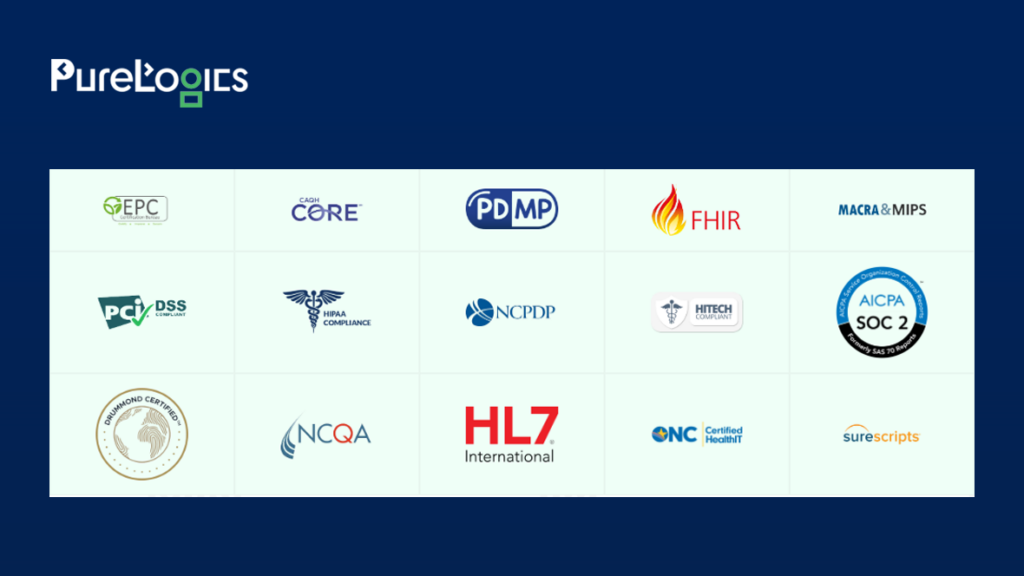
Certifications, Standards, and Compliance Expertise
Planning an EHR or EMR Project?
Get expert guidance on architecture, interoperability, and compliance before you build.
2. Itransition
Itransition offers a suite of EHR software development services including consulting, migration, modernization, integration, and implementation. Its delivery approach covers workflow and requirements analysis, engineering, data migration, quality assurance, and ongoing issue resolution.
Their range of capabilities matters most when a project is not confined to a single app. Healthcare organizations often need their EHR to connect with patient portals, telehealth platforms, lab systems, practice management systems, or finance apps.
Ideal Fit: Large-scale transformation programs spanning multiple apps, departments, or post-launch support.
3. Edenlab
Edenlab’s EHR software development services focus on cloud and FHIR-native architecture, covering end-to-end development, integration, and modernization. This fits organizations building EHR products for broad interoperability and is suitable for those who need FHIR, HL7, or embedded clinical decision support as core features.
Ideal Fit: Cloud-native or FHIR-native EHR products pursuing ONC certification or multi-system interoperability.
4. Chetu
Chetu’s EHR software development services cover custom EHR builds, consulting, integration, migration, e-prescribing, laboratory connectivity, and revenue cycle capability. It can build an EHR with capabilities such as computerized provider order entry, HL7 integration, and clinical decision support. Furthermore, it is suitable for buyers who need multiple development workstreams, a dedicated team (front-end and back-end), and data engineering.
Ideal Fit: It is the best fit for prospects looking for staff augmentation, EHR development, and product extensions.
5. Arkenea
Arkenea is a software development company and offers EHR software development services including consulting, product development, modernization, migration, and support. This focus can help founders decide whether they need a stand-alone platform, a specialty module, an app connected to their existing EHR, certification, or support requirements depending on needs.
Ideal Fit: It is best for healthcare SaaS providers, digital health startups, certification responsibilities, and support capability.
AI in Custom EHR Software: What Is Actually Worth Building?
For the first time in healthcare, there is a technology that can help practitioners map context and more. Here’s how the current wave of EHR AI capabilities breaks down, from automation to clinical documentation.
- Concises long records into pre-visit or in-visit summaries, identifying incomplete data.
- Predicts no-shows, cancellations, and spikes in workload so practitioners can plan and prepare in advance.
- Auto-generates discharge instructions, follow-up reminders, and intake questionnaires linked directly to the documented care plan.
- Suggests visit-level and procedure codes from documentation and identifies claims that are similar to past denials or undercoding patterns.
- Converts encounter conversations into structured EHR entries mapped to ICD-10, CPT, and SNOMED CT, with clinicians reviewing before anything is entered into the chart.
What to Look for in Custom EHR Software Development Services?
Not every custom healthcare software development company offers EHR software development services that can execute across the full scope a real project needs. Below are the things you should look for before you finalize your EHR development partner.
- Long-term support and maintenance, not just delivery at launch.
- Proven HIPAA compliance and certification history, with audit-ready processes.
- An elaborated and planned approach to legacy data migration with zero data loss.
- Measurable AI capabilities with clinical or administrative impact, including how safely they handle PHI.
- Good interoperability track record with HL7, FHIR, and real-world lab, pharmacy, or billing integrations.
Selecting the right custom EHR software development company is not easy. But you can start by checking their portfolio, ratings, and reviews on platforms like Clutch, etc. So the first step you can take is to shortlist two or three companies and verify their track record before a single sales call.
Additionally, before signing with anyone, make sure to ask about:
- Post-launch support
- PHI handling practices
- Quality assurance and testing processes
- Proven AI deployments in production environments
If PureLogics is on your shortlist, the fit comes from 19+ years of healthcare-focused engineering and HL7/FHIR/DICOM interoperability. Plus, compliance coverage spanning HIPAA and HITECH. A 30-minute call (schedule here) is enough to tell you whether we’re the right match.
Frequently Asked Questions
1. How to develop your own EHR?
Developing an EHR requires healthcare expertise, regulatory compliance, interoperability standards, and secure software architecture. In addition, you will need features such as patient records, charting, scheduling, billing, and integration with healthcare systems. However, the process is complex and highly regulated; partnering with or hiring a custom EHR software development company can help reduce implementation risks and ensure compliance.
2. How long does it take to develop an EHR system?
A basic MVP takes 3-6 months, whereas a full enterprise-ready EHR with integrations, billing, and compliance takes 9-18 months. But development time is highly dependent upon the features and complexity of the solution. You can contact us to get the exact outline.
3. Can a custom EHR integrate with my existing clinic or hospital system?
Yes, custom EHRs can integrate smoothly with billing software, radiology systems, lab, pharmacy networks, and legacy EHRs. Using interoperability standards like HL7 and FHIR, they can securely exchange data across systems while supporting your existing workflows.