


 [tta_listen_btn]

 August 26 2026

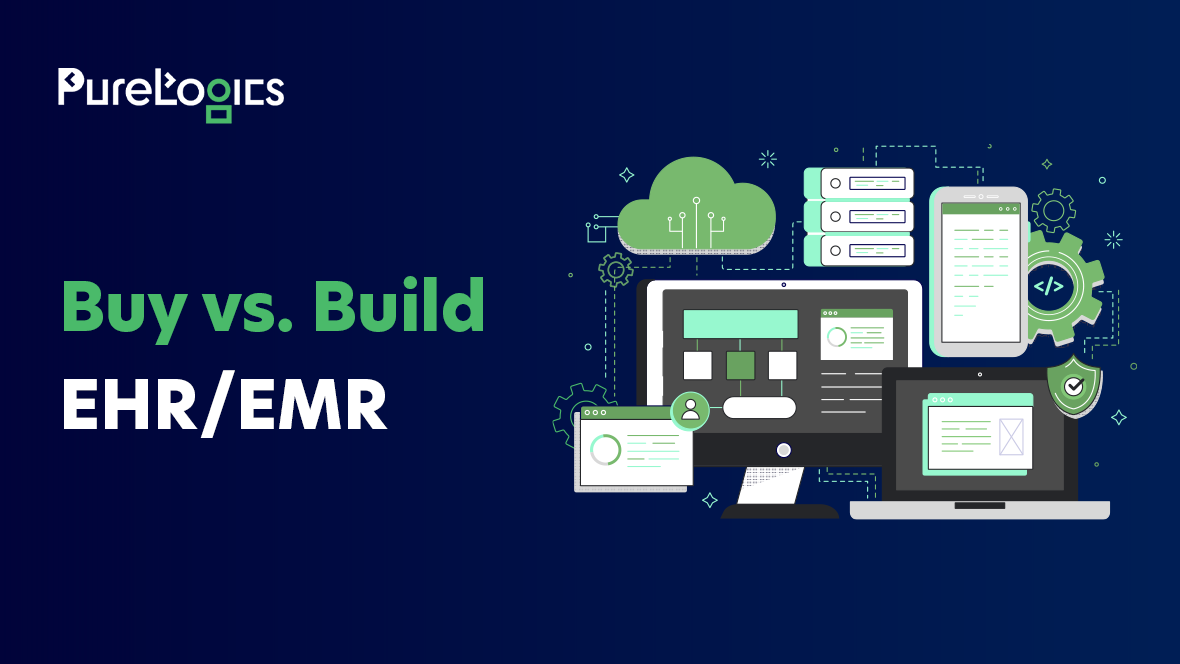
Building or buying EHR/EMR software remains one of the most critical decisions healthcare leaders face in the age of AI.
At first glance, buying seems cheaper and faster.
However, the real answer depends on your workflows, growth plans, and long-term business goals. It is true that for healthcare providers, buying seems like a perfect option. But off-the-shelf EHR software can become expensive over time, and the common issues that healthcare providers can face are:
- Vendor lock-in
- Slow customizations
- Workflow mismatches
- Per-user license growth
- Integration limitations
- Expensive feature upgrades
- Restricted reporting flexibility
Moreover, in the AI era, flexibility is critical, and ready-made EHRs can make it difficult to customize workflows and integrate emerging AI tools. For instance, custom EHR software with AI features can write notes, suggest codes, and identify the right patient before the physician asks.
Undoubtedly, the development cost of EHR software may seem expensive. But phased implementation spreads cost over time, allowing organizations to build only what they need, when they need it. Or hiring an EHR or EMR development team on an hourly basis can also help reduce cost.
Buy vs. Build EHR: Growth, Adoption, Challenges 2026 & Beyond
EHR adoption does not always translate into user satisfaction. A JAMA Network Open survey of 2,067 family physicians found that only 27% were satisfied with their EHR. In contrast, workflow alignment, ease of finding information, and data entry were associated with higher satisfaction.
This highlights a key consideration in the buy-vs.-build decision: an EHR should fit clinical workflows, rather than forcing physicians to adapt to the software. Some other reasons for custom EHR software development that can fit this year and beyond are given below:
Evolving Regulations
Government regulations are evolving rapidly, especially regarding healthcare interoperability. Whether it’s CMS-0057 or TEFCA, all are pushing healthcare organizations toward standardized data sharing through FHIR APIs and common exchange frameworks. To effectively meet all these requirements, robust EHR software is required.
AI-Enhanced EHR
Globally, the EHR market is expected to grow from $12.46B in 2026 to $35.65B by 2030. This growth reflects the increasing role of EHRs in shaping healthcare.
Besides, AI-powered clinical decision support, predictive analytics, automated documentation, interoperability, and personalized care are becoming more important. Here, custom EHRs can give healthcare organizations the flexibility to integrate these capabilities around their specific workflows and needs.
Rising Integration Demands
Healthcare organizations require EHRs to connect with labs, pharmacies, medical devices, patient portals, billing systems, and third-party apps. In this context, custom EHR development can offer greater control over these integrations, helping organizations create connected workflows around their specific needs.
Value-Based Care
The shift toward value-based care requires healthcare organizations to track outcomes, quality measures, patient engagement, and cost. Custom EHRs offer tailored workflows and reporting tools that can help monitor these metrics and align care delivery with value-based goals.
These trends set the stage, and regulatory changes mandate healthcare leaders to find ways to optimize EHR value. Undoubtedly, off-the-shelf vendors dominate the market, but custom-built systems deliver tighter workflow alignment and better patient engagement. However, it is important to remember that the right choice between build or buy is not the same for every healthcare organization. Eventually, this decision depends on factors such as organization size, workflow complexity, budget, and the level of customization required.
Another approach gaining popularity is a hybrid model that extends commercial platforms with custom middleware, integrations, workflow modules, or surrounding infrastructure. This approach lowers rebuild risk while improving flexibility, and in some cases it becomes the smartest transitional path.
Build vs. Buy vs Hybrid by Healthcare Organization Type
Different healthcare organizations may benefit from different approaches between build vs buy and hybrid. The following table can help healthcare leaders identify which approach best fits their organization.
Healthcare Organizations | Better Fit | Reason |
| Small clinics | Buy | Lower upfront cost and faster deployment |
| Speciality Practices | Build/Hybrid | Unique workflows may require more customization |
| Multi-speciality groups | Hybrid | Need standard EHR capabilities with room for custom workflows |
| Hospitals & health systems | Build/Hybrid | Complex workflows, integrations, scalability, and data requirements |
| Large enterprise healthcare organizations | Hybrid | Can use a core EHR while building custom applications around it |
Every healthcare organization has unique operational and technology needs; that’s why a deeper evaluation of workflows, integrations, and scalability is essential before making a final decision.
Cost Breakdown: Build vs. Buy EHR Software
As stated above, off-the-shelf EHRs may seem cheaper initially, but recurring licensing, upgrade, customization, and integration costs can add up. In contrast, custom EHRs have a higher upfront cost, but phased development can spread costs over time while providing greater control over long-term expenses. Let us imagine the five-year scenario here.
| Factor | Off-the-Shelf | Custom EHR Software Development |
| Initial Cost | Lower subscription fee for onboarding and implementation | Higher because of implementation, development, and certification |
| Customization | Often requires vendor-supported changes or additional fees | Workflows and features can be built around organizational needs |
| AI Integration | Highly dependent upon vendor APIs and capabilities | Greater control over AI integration and architectures |
| Scaling Cost | Increases as the number of modules or users increases | Only infrastructure and maintenance cost |
| Vendor Cost | Higher because vendor controls updates and product roadmap | Lower because owner can have full control over planning and development |
Quick Decision Checklist
Choosing between building, buying, or adopting a hybrid EHR approach is not always straightforward. The questions below can help determine which option best aligns with your organization’s goals, workflows, and long-term strategy.
- Is patient volume growing quickly or fairly stable?
- Is your budget upfront-heavy or spread-over-time-friendly?
- Do you need to integrate AI tools now, or in the near future?
- Do your workflows fit standard EHR templates, or need specialty-specific customization?
Why This Decision Matters Now
An EHR platform is a core operational infrastructure for clinical teams because administrative teams rely on it for workflows, scheduling, billing, record management, and compliance. Whether you choose to buy, build, or go for a hybrid approach, your goal should be to choose an EHR strategy that gives you room to evolve. A 30-minute free call with our experts can help you evaluate options and build the right EHR software. With two decades of experience, we help healthcare providers develop EHR software that fits their workflows, supports their goals, and adapts to evolving needs.
Explore our EHR development services to see how we can help you build the right solution.
Frequently Asked Questions
Can I create my own EHR?
Yes, you can develop your own EHR software solution according to your integrations and clinical needs. However, EHR software development requires careful planning around HIPAA compliance, data security, and interoperability, which can be complex. That’s why hiring a custom EHR software development team can be the best option, especially if you are on a tight budget, because they also offer the option to hire on an hourly basis.
What are the pros and cons of the build vs buy approach in EHR/EMR software development?
Building an EHR offers greater control over customization, workflows, integrations, AI capabilities, and long-term development. But requires higher upfront investment and ongoing technical support. In contrast, buying an EHR involves licensing costs, vendor lock-in, limited customization, and dependence on the vendor’s roadmap, eventually increasing the cost over time.
What EHR/EMR do most hospitals use?
The choice of EHR/EMR depends on a hospital’s size, workflows, specialty needs, budget, and integration requirements. Right now, Epic is considered one of the most widely used EHR platforms. But the right system depends on how smoothly it integrates with existing labs, pharmacies, systems, medical devices, patient portals, and other healthcare apps.