


 [tta_listen_btn]

 October 14 2026

You can invest in a new patient portal, approve an AI pilot, or add another analytics platform and still find your teams struggling to access reliable data.
When EHRs, claims platforms, laboratories, and other tools cannot exchange information reliably, teams spend more time cleaning, checking, and reconciling data. The resulting workload consumes resources across IT, operations, analytics, and reporting.
The problem is common across healthcare organizations. Deloitte reports that 79% of healthcare executives consider data silos and poor interoperability major barriers to digital transformation.
Over time, the extra work and delays add up, making fragmented data a costly problem for healthcare organizations.
So how do you know where fragmentation is costing your organization the most?
The right metrics can help executives identify these costs and decide where to focus their efforts.
Why is Fragmented Healthcare Data an Executive Problem?
Fragmented healthcare data can affect how organizations measure performance, allocate budgets, and plan digital initiatives. When information sits across disconnected systems, getting a clear picture of operations becomes harder.
Healthcare data management becomes more complex when systems store, define, and update information differently. These differences can make it difficult to compare data across departments.
As a result, organizations may have access to the information they need without having a complete, reliable view of their performance.
That gap tends to show up in three areas:
- Digital initiatives: New tools can take longer to launch when existing systems cannot exchange the data they need.
- Accountability: When data definitions and quality vary across systems, it becomes harder to determine who owns the problem.
- Decision-making: Leaders may receive conflicting figures for the same measure and have to wait while teams reconcile the differences.
IT teams can build and maintain the connections, but the business must set priorities. Executives need to identify which data matters most, where better healthcare interoperability can have the greatest impact, and who owns improvement efforts. A clear healthcare data strategy can help align these priorities with broader business goals.
Is Fragmented Data Draining Your Budget?
Build healthcare software that simplifies data exchange, reduces avoidable manual work, and supports more cost-effective operations.
What are the Hidden Costs of Fragmented Healthcare Data?
When teams repeatedly reconcile records, troubleshoot integrations, or validate reports, the time and resources required to make data usable across systems add up. To identify the biggest cost drivers, look beyond the number of systems and measure the work required to connect them.
The following are some of the key areas where healthcare data silos add to organizational costs:
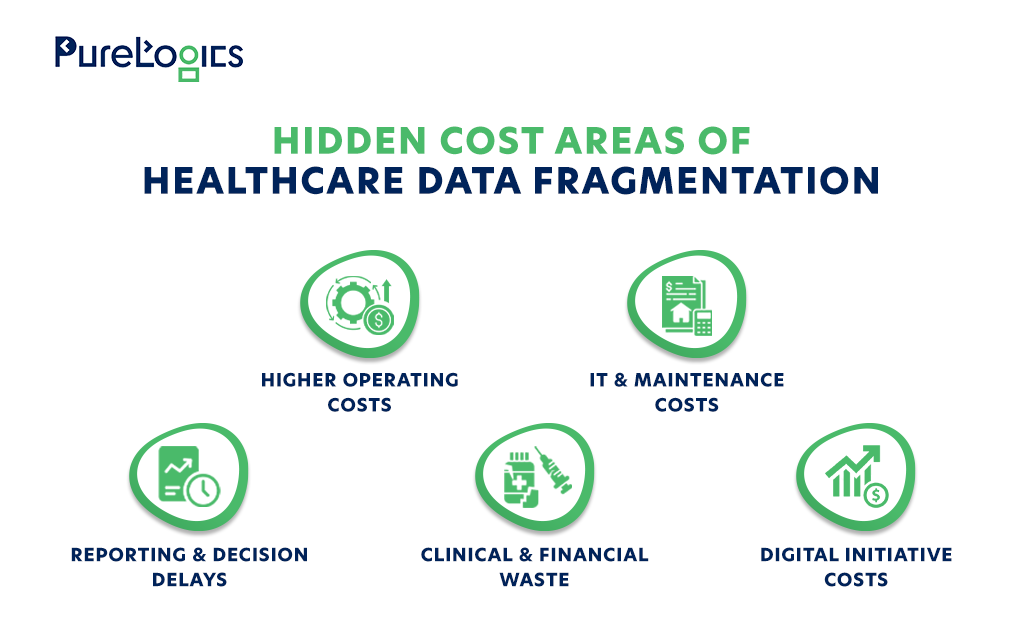
Higher Operating Costs
Disconnected data can turn routine tasks into manual work. Your teams may need to compare records, correct discrepancies, or enter the same information across multiple systems before a process can move forward.
Gartner estimates that poor data quality costs organizations an average of $12.9 million each year, as teams lose resources and opportunities dealing with unreliable data.
That effort adds up when the same tasks occur across departments. Staff can spend hours checking and reconciling information that should already be available, increasing the time and resources needed to complete routine work.
IT and Maintenance Costs
Healthcare organizations rely on data integration to move information between EHRs, claims platforms, laboratories, analytics tools, and other systems. These connections support healthcare data exchange, but they also require ongoing monitoring, testing, troubleshooting, and updates as systems change.
The cost does not end when an integration goes live. Your IT team may continue spending time maintaining connections, especially when a change in one system affects others. As the number of connections grows, the effort required to keep them working reliably increases.
Reporting and Decision Delays
Data may be available without being ready for decision-making. Analysts often need to check definitions, investigate discrepancies, and validate information before they can use a report with confidence.
That extra work can extend reporting timelines. For executives, this means waiting longer for reliable information before making decisions. Manual validation across multiple systems can slow even routine requests.
Clinical and Financial Waste
Data gaps and inconsistencies can create unnecessary work across clinical and administrative processes. Repeated data entry, error correction, and reconciliation consume resources without improving the underlying workflow.
Your clinical staff may spend additional time verifying information, while administrative teams may need to resolve discrepancies before reporting, billing, or coordination can move forward.
Over time, these inefficiencies can increase administrative costs and add more work to already complex healthcare processes.
Higher Digital Initiative Costs
New technology still depends on the data and systems already in place. An AI application, analytics platform, or patient-facing tool may need additional integration, data preparation, or workflow changes before it can deliver its intended value. Fragmented data can become an even bigger concern when organizations try to scale AI across multiple systems.
When underlying data is hard to access, connect, or prepare, teams may need more time and resources to make new technology work across existing systems. That can increase implementation costs and extend project timelines.
Which Metrics Should Executives Track?
Once the hidden costs are clear, the next step is to determine where they occur. A small set of consistent metrics can show how much time, effort, and delays fragmented data creates across the organization.
The following metrics can help executives identify where the biggest gaps are:
| Metric | What to Track | What It Tells You |
| Duplicate record rate | Percentage of records that duplicate another record | Where inconsistent patient or business data creates rework and billing errors |
| Data completeness | Percentage of required information available across connected systems | Where missing data limits reporting, analytics, or workflows |
| Integration failure rate | Percentage of data transfers that fail, are delayed, or are interrupted | Which system connections disrupt workflows |
| Integration maintenance effort | Time spent monitoring, updating, and troubleshooting integrations | How much IT capacity goes to keeping existing connections running |
| Data reconciliation time | Hours spent comparing, correcting, and validating information across systems | How much staff time goes into manual data cleanup |
| Time to deliver trusted reports | Time from a data request to a validated report | How long leadership waits for information it can act on |
These metrics are more useful when viewed together. For example, high reconciliation time alongside frequent integration failures can indicate that system connectivity is contributing to the problem rather than a few isolated data errors.
Tracking these measures over time can also show whether integration efforts are reducing underlying costs. Start with the areas showing the greatest operational impact, establish a baseline, and use those measures to track progress.
Building a More Connected Data Environment
Fragmented healthcare data can quietly increase costs, slow reporting, and create more work for teams. But measuring these effects gives healthcare leaders a clearer view of where integration needs attention.
For organizations building connected systems and reducing data silos, a reliable healthcare software development approach can align systems, data requirements, and workflows from the start. This gives teams a stronger foundation to support new digital initiatives without adding more disconnected systems. Turn data silos into connected care systems. The PureLogics team helps healthcare organizations bridge data gaps through tailored software development and integration
Frequently Asked Questions
What causes healthcare data fragmentation?
Healthcare data fragmentation can result from disconnected EHRs, claims systems, laboratories, patient portals, and other applications. Legacy systems and inconsistent data formats make it harder to exchange information across them. Limited interoperability and point-to-point integrations can add to the problem.
How does fragmented healthcare data affect healthcare organizations?
Fragmented data can increase manual work, slow reporting, and make data reconciliation more difficult. It can also increase IT maintenance demands and add time and cost to data-dependent digital initiatives.
How can healthcare organizations reduce data fragmentation?
Start by identifying where disconnected systems create the most operational friction. Then prioritize the data and integrations that have the greatest impact. An experienced EHR integration partner can help close gaps between systems, improve interoperability, standardize data exchange, and monitor data quality to support a more connected data environment over time.