


 [tta_listen_btn]

 June 10 2026

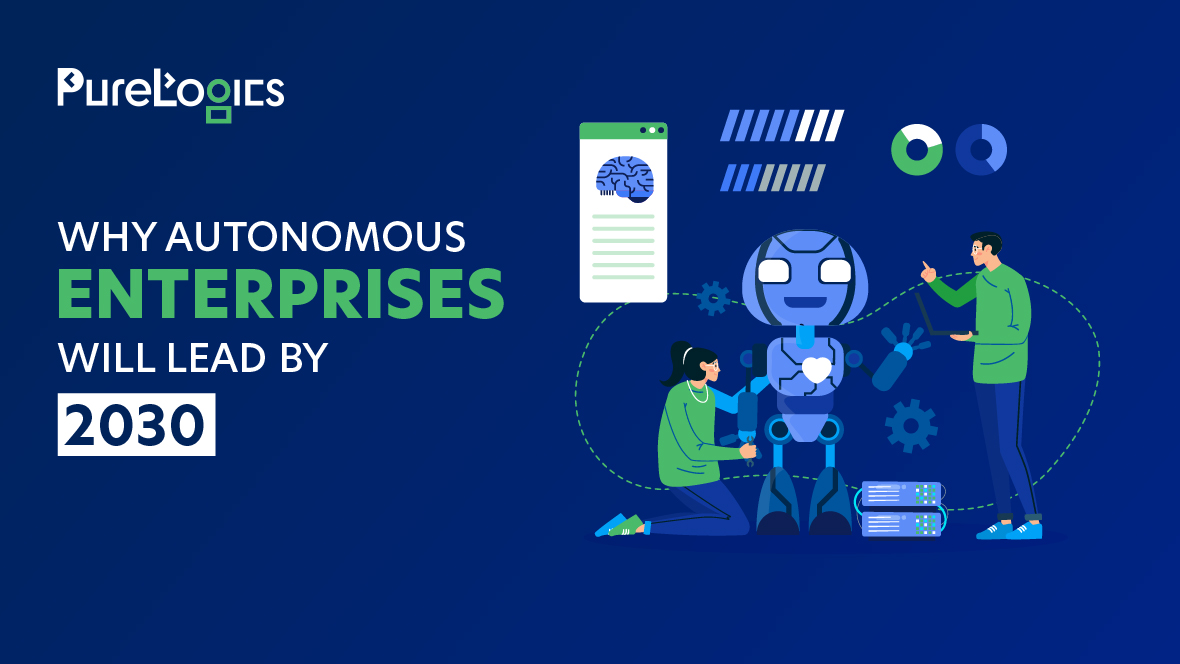
A Gartner survey of 469 CEOs conducted through Q4 2025 found that 54% of enterprises limit automation to specific tasks. By 2028, only 13% expect to remain at that level, indicating a small but significant group already moving ahead while others are still early in the journey. This reflects a broader shift in how enterprises will execute work, make decisions, and respond to market dynamics, marking the early stages of the autonomous enterprise transition, where the performance gap between early adopters and laggards is expected to widen significantly.
The autonomous enterprise is a business model in which self-learning software agents and machine-driven processes make decisions, execute workflows, and create value with minimal human intervention at the operational level. Moreover, Gartner defines the autonomous business as a strategy in which self-learning software agents and machine customers make decisions, take action, and create new types of value for businesses. Noting that while digital business changes what an organization does, autonomous business changes how it does it.
This distinction matters to CEOs, COOs, and CFOs because operational efficiency is no longer the competitive advantage, but speed of adaptation is.
The dimensions that differentiate traditional enterprises from autonomous ones are:
| Dimension | Traditional Enterprise | Autonomous Enterprise |
| Decision-making model | Multi-layer approvals slow execution | AI agents execute decisions in real time within defined guardrails |
| Workflow execution | Manual coordination across teams and systems | AI-orchestrated workflows with human oversight |
| Cost structure | Linear cost growth tied to headcount and overhead | Scalable automation with lower marginal cost per process |
| Competitive advantage | Efficiency and incremental optimization | Speed of adaptation and autonomous execution |
What Makes an Autonomous Enterprise Structurally Different
In contrast to traditional enterprises that depend on predefined workflows and human-driven decision-making, autonomous enterprises continuously learn and adapt. Their core advantage lies in creating self-optimizing systems that can respond to changing conditions.
1. Decision Velocity Replaces Decision Hierarchy
In a traditional setting, a performance signal moves upwards through management layers before a response moves back down. In an AI-driven enterprise, that cycle is compressed significantly, with routine operational decisions handled automatically and exceptions escalated to human stakeholders.
Gartner predicts that at least 15% of day-to-day work decisions will be made autonomously through agentic AI by 2028, up from 0% in 2024. That shift does not sound dramatic in percentage terms. For the COO, this trajectory indicates planning, and even a modest percentage of autonomous decision-making can fundamentally change how work is coordinated, how resources are allocated, and how quickly businesses respond to change.
All in all, it is time for C-suite leaders to redesign their processes, governance models, and workforce structures to operate in an environment where speed, adaptability, and machine-led execution become core competitive capabilities.
2. Hyperautomation Is the Foundation of the Autonomous Enterprise
An autonomous enterprise does not emerge from AI pilots; rather, it is built on a hyperautomation foundation. Hyperautomation is the coordinated deployment of artificial intelligence, machine learning, and robotic process automation to digitize and automate complete end-to-end processes. It reduces the decent percentage of manual handoffs.
Gartner has confirmed that hyperautomation remains a strategic priority for 30% of large enterprises. This near-universal prioritization shows that the baseline is shifting. Businesses not actively building hyperautomation infrastructure are falling behind on a standard that competitors already treat as mandatory.
For a CFO, that market trajectory has a direct implication, and the question is no longer whether to invest in AI talent, but how quickly they can build the capabilities required to compete in an increasingly autonomous market. Enterprises that develop AI expertise today will be better positioned to control costs and avoid paying a premium to catch up.
3. Agentic AI Converts Automation Into Autonomy
Hyperautomation automates defined processes, but agentic AI goes further by planning, recommending actions, and executing portions of multi-step workflows while keeping humans involved in higher-risk, ambiguous, or strategic decisions.
Gartner predicts that 40% of enterprise apps will be integrated with task-specific AI agents by the end of 2026, up from less than 5% in 2025. It also forecasts that AI agent software spending will reach $206.5 billion in 2026 and $376.3 billion in 2027, up from $86.4 billion in 2025. That investment is being made by businesses that have concluded agentic AI delivers measurable business returns, not by businesses running experiments.
For a CEO, the question is not whether AI-driven enterprises will operate at a different performance level from traditional ones; the research confirms they will. Now the question is whether your enterprise will be among AI-driven ones or among traditional ones that are still calibrating their responses.
What the Autonomous Enterprise Advantage Looks Like by 2030
By 2030, the performance difference between autonomous and traditional enterprises will be visible across the dimensions given below:
Operational throughput
Autonomous systems execute predefined actions without requiring approval at every step, while escalating exceptions and high-impact decisions to human operators. This leads to shorter process cycle times, lower error rates, and capacity scaling without proportional increases in headcount. AI-driven enterprises analyze more data across more sources faster than the human decision cycle allows.
Market responsiveness
Gartner notes that by 2030, machine customers could drive or influence $18 trillion in purchases, marking an era in which autonomy supported by human governance, rather than automation alone, sets leading organizations apart.
Capital efficiency
Grand View Research projects the generative AI market size will reach $324.68 billion by 2033. This value will not distribute evenly; rather, it will concentrate in organizations that have deployed infrastructure to capture it.
Strategic Decision Facing C-Suite Leaders Today
The autonomous enterprise is not a future state that enterprises can defer; rather, it’s a competitive dynamic. Moreover, those building autonomous capabilities for 2030 are not doing so in anticipation of 2030. They are doing it because the returns are measurable today and the compounding advantages justify the investment.
At the same time, the barriers are also real; for instance, legacy system integration is technically complex, and governance infrastructure requires deliberate design. Not to forget, cross-functional change management is operationally demanding, and none of these barriers will disappear by waiting.
Consequences of Not Becoming an Autonomous Enterprise
- 3x Higher Productivity Gap: PwC study on Global AI Jobs found that industries most exposed to AI are already achieving up to 3x higher growth in revenue per worker, meaning non-adopters are structurally falling behind in output efficiency and value creation.
- 66% Faster Skill Disruption: The same PwC study also finds that in AI-exposed roles, required skills change 66% faster than in traditional roles, increasing reskilling pressure for businesses that delay automation.
- Strategic irrelevance risk: As noted above, Gartner predicts that 40% of enterprise apps will include task-specific AI agents by 2026, making legacy operating models increasingly incompatible with future enterprise systems.
Who Will Outperform in 2030
The enterprises that will outperform by 2030 are making one decision today: treating the transition to an autonomous enterprise as a CEO-level strategic priority. Businesses that delay face measurable and compounding disadvantages.
However, 40% of agentic AI projects are forecast to fail by 2027, primarily due to inadequate governance, unclear ROI, and escalating costs. Moreover, the ones avoiding this outcome share one characteristic: they are building a hyperautomation foundation before attempting to scale autonomously. This means automating defined processes end-to-end first, minimizing manual handoffs and fragmentation, before deploying agentic systems that require clean operational data to function reliably.
Enterprises jumping directly to agentic AI without this foundation face higher failure rates and lower returns. If you are unsure where your enterprise sits in that sequence. Our AI engineers can assess your current automation maturity, identify the integration gaps holding your systems back, and define the exact path from where you operate today to where the autonomous enterprise standard will require you to be. Schedule your assessment.
FAQs
1. What is an autonomous enterprise?
They use self-learning AI agents and machine-driven processes to support decision-making and execute workflows, while humans provide governance, oversight, and intervention where judgment is required. In contrast, traditional automation follows fixed rules and predefined processes; an autonomous enterprise continuously learns, adapts, and optimizes operations in real time in response to changing conditions.
2. How can an enterprise become an autonomous enterprise?
An enterprise can begin by assessing its current automation maturity and identifying high-impact processes for hyperautomation and the deployment of agentic AI. PureLogics helps enterprises design and implement a structured roadmap toward autonomous capabilities, starting from foundational automation to enterprise-wide AI-assisted operations.
3. What role does the autonomous enterprise play in future competitiveness?
The autonomous enterprise will become a key source of competitive advantage by 2030 because it enables businesses to make faster decisions, reduce costs, and adapt more quickly to change. However, those that adopt this model early will outperform traditional approaches because they can act faster and use AI to improve decision-making at scale.