


 [tta_listen_btn]

 July 22 2026

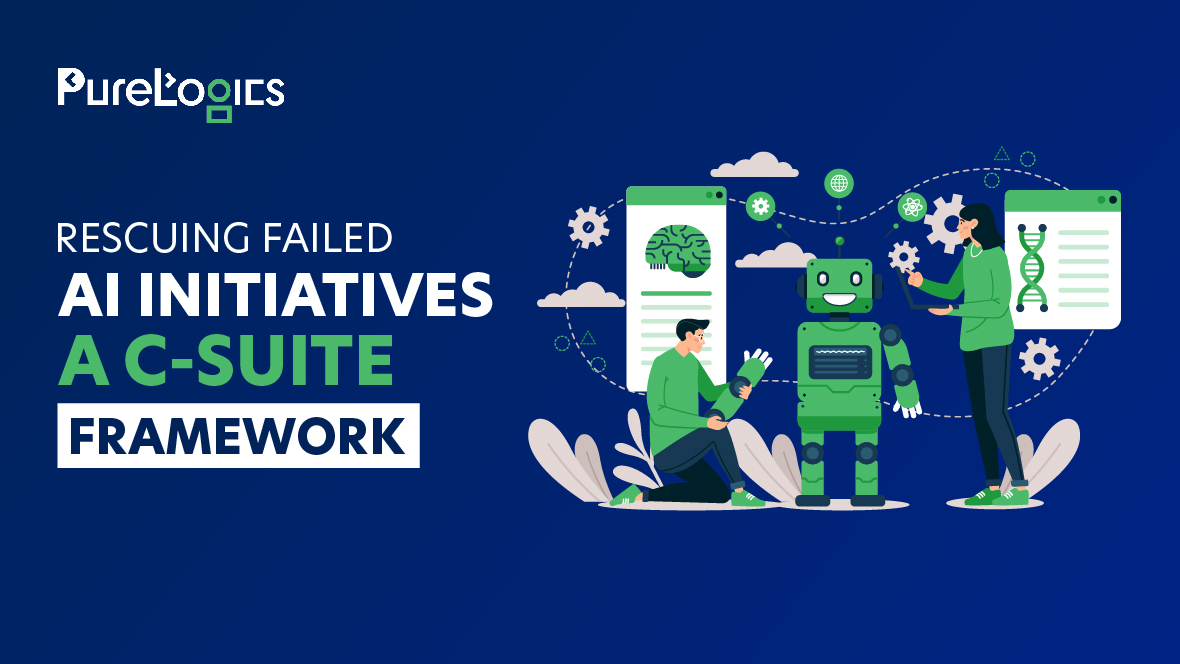
AI initiatives do not usually die from bad technology; rather, they die the way most underperforming projects die. That is, the executive approved a budget, a team built something, and eighteen months later nobody can demonstrate a measurable impact on revenue growth, cost reduction, or operational efficiency. This becomes the defining governance failure of the current AI transformation cycle, and it is now large enough that most boards will have to address at least one stalled AI program before the year is out.
The AI Transformation Gap & What the Data Shows
The scale of the problem is no longer a matter of opinion, as several surveys and studies point out:
- MIT researchers noted that 95% of generative AI pilots failed to deliver a return on investment.
- McKinsey’s latest State of AI report found that 39% of organizations report any enterprise-wide EBIT impact from AI, with most seeing less than 5%.
- Gartner’s most recent survey of 782 Infrastructure and Operations (I&O) leaders found that only 28% of AI use cases fully succeed and meet ROI expectations, while 20% fail outright.
These numbers describe the same pattern from three angles: adoption is nearly universal and value is rare. Plus, the gap between the two is not closing on its own.
4 Reasons Behind Failure of AI Initiatives
The root causes behind the failure of AI initiatives are below, and none of them are primarily technical.
1. Expectations Outrun Reality
Melanie Freeze, the Gartner analyst, found that 57% of leaders who experienced an AI failure attributed it to expecting too much, too fast. Teams assumed AI would immediately solve operational problems that had never been solved manually either.
2. Data Was Never Ready
The same Gartner survey of 782 I&Os says that 38% of leaders who faced setbacks cited persistent skill gaps as a cause of AI project failure. Furthermore, Roxane Edjali of McKinsey noted that 60% of organizations will abandon AI projects that lack properly governed, AI-ready data.
3. Workflows Never Redesigned
McKinsey analysis of 25 factors tested against EBIT impact found that redesigning workflows had the single largest effect on whether an organization saw bottom-line value from AI. This challenge is especially visible in generative AI, where only 21% of organizations report having fundamentally redesigned a workflow around the technology. Most AI still sits atop old processes rather than replacing them.
4. Governance Stopped at the Pilot
McKinsey’s State of AI also found that CEO-level oversight of AI governance was among the factors most strongly correlated with reported bottom-line impact. When accountability for an AI initiative lives two or three layers below the C-suite, there is no one positioned to make a call to continue, redesign, or discontinue it.
None of this means the technology underperformed. Instead, most organizations managed their AI initiatives with less rigor than they would apply to a much smaller capital project.Many also lacked a clear AI business strategy to guide the rollout.
A C-Suite Framework for Enterprise AI Recovery
Fixing a stalled AI initiative works best when it is treated as a governance exercise with three distinct owners, rather than a single fix owned by the team that started the initiative. For a leadership team asking how to implement AI in business in a way that actually sticks, this ownership structure is the starting point.
| CEO [owns the mandate and the capital decision] |
| The CEO’s role is to decide, in business terms, whether the original case for the initiative still holds, and to attach real capital and accountability to whichever answer follows. McKinsey found that among high-AI high performers, organizations intend to use AI for transformative change, with leadership that tends to treat AI governance as a CEO-level responsibility. |
| CTO [owns the technical diagnosis] |
| The CTO’s AI mandate or recovery role starts with data, not the model. Align data to specific use case, actively governed at the asset level, and continuously monitor its quality. Any initiative that cannot meet the bar should be relaunched until it does, regardless of how promising the original pilot looked in demo. |
| COO [owns workflow integration] |
| The COO is responsible for the part most initiatives miss or skip: rebuilding the actual workflow around the AI capability rather than just bolting AI onto the existing workflow. As Deloitte notes in its State of AI in the Enterprise study, despite high expectations for automation, 84% of companies have not redesigned workflows around AI capabilities. |
Organizations closing the gap between AI adoption and AI value are not running more pilots. They are applying the same governance discipline to AI transformation that they use for every other major capital decision:
- A clear owner
- A defined metric
- A data foundation
- A workflow actually rebuilt
All in all, the real AI transformation starts with an assessment of AI systems that tells which of these four is missing.
AI Initiative Rescue Readiness Framework
| Decision Dimension | Rescue Signal | Common Gap | Recovery Action |
Business case | Ties to >$200K/year in cost or revenue | Never quantified in business terms | Re-anchor to a measurable profit & loss line |
Data readiness | Governed, use-case-aligned, quality-assured | Assumed ready, never audited | Run a data-readiness audit first |
Workflow redesign | Workflow can be rebuilt around AI | AI bolted onto the old process | Redesign the workflow, not just the tool |
Success metric | Measurable KPI in place | No metric set at launch | Define one now, even retroactively, so recovery can be judged against something because without a KPI, progress cannot be measured. |
Your Next Move
For any executive team facing a stalled AI initiative, the fastest path forward is usually an AI assessment, as noted above. PureLogics works with enterprise leadership teams to run an AI assessment, map a stalled AI initiative against its original business case, data readiness, and workflow integration, and build the recovery plan. If your organization’s AI initiative has stalled, a structured assessment is faster than a second attempt at the same rollout. A 30-minute call (schedule here) is usually enough to tell you whether the case still holds.
FAQs
Why do AI projects fail?
They often fail because organizations lack clear business goals, quality data, executive alignment, or a plan for scaling. Many focus on the technology before defining how AI will create measurable business value.
What is the first step in AI transformation?
The first step in AI transformation is identifying a business problem that AI can solve. Then evaluate whether the business has the data and processes required to achieve measurable results. An AI assessment can help uncover gaps before significant investments are made.
How to rescue a stalled AI project?
You can rescue a stalled AI initiative by reassessing its business case, data readiness, workflow integration, and governance structure. Most importantly, assigning clear executive ownership and linking the initiative to measurable business outcomes can help get it back on track.